Andy White Anthropology
  • Home
  • Fake Hercules Swords
  • Research Interests
    • Complexity Science
    • Prehistoric Social Networks
    • Eastern Woodlands Prehistory
    • Ancient Giants
  • Blog

The Middle Archaic of the Eastern Woodlands: Where's the Love?

3/4/2016

 
I am willing to bet that if you asked every archaeologist in the Eastern Woodlands vote for his or her favorite chunk of prehistory, less than five percent would say "Middle Archaic."  The Middle Archaic probably wouldn't make many Top Ten Most Interesting Sub-Period lists (most of us divide prehistory into eleven or twelve sub-periods).  It might win the vote for "Most Boring," presuming people remember that it exists. If the Middle Archaic went to the Eastern Woodlands archaeological prom, it would probably spend the evening standing quietly against the wall.  But it probably wouldn't get invited anyway.  And it will get picked last for dodge ball every time. That's a given.

I feel you, Middle Archaic, I feel you.

Based on the looks on my students' faces during class yesterday, the lack of enthusiasm for the Middle Archaic is not limited to professionals.  I'm lucky I had a few slides about the Lizard Man of Lee County to get the lecture going. It was all downhill from there. Perhaps the proximity of spring break contributed, and perhaps it just wasn't my best-prepared or best-delivered class.  But I think their lack of interest in the Middle Archaic is, like that of many archaeologists, real.
​
Where's the love for the Middle Archaic?

The privation suffered by the Middle Archaic is certainly not due to a lack of importance. It is the longest sub-period in Eastern Woodlands prehistory, consuming three thousand years between about 8000 and 5000 radiocarbon years before present (RCYBP) (~8900-5800 calibrated YBP; ~6900-3800 BC). While there is still much we don't understand about what happened during those three millennia, we do know that the societies that emerged at the end of the tunnel were quite different than the Early Archaic societies of the earliest Holocene. The Late Archaic world was filled with semi-sedentary societies inter-connected by webs of ritual and exchange that moved artifacts across vast distances of the east. Many Late Archaic societies were somewhat dependent on domesticated plants. There is evidence of territoriality, violence, and perhaps incipient craft specialization. The population of the Eastern Woodlands was undoubtedly significantly higher than it had been a few thousand years earlier. Between 8000 and 5000 RCYBP, just about everything changed.

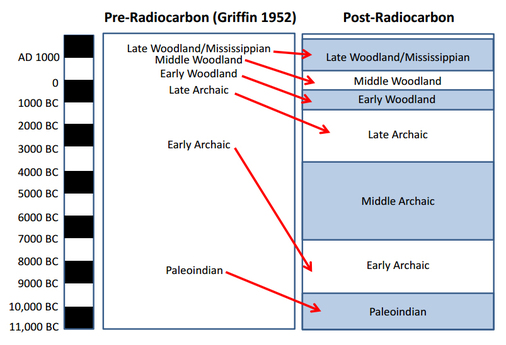
The Archaic middle child, however, just doesn't rate much interest in many regions. My impression is that some of that neglect is due to the nature of the material culture -- much of the lithic technology of the Middle Archaic is just not objectively pretty.  And in some parts of the country, like the Midwest, we still have difficulty identifying Middle Archaic sites based on stone tools. Either we're not recognizing the point styles as Middle Archaic or there just aren't that many sites. The situation is different in the Carolinas, where Middle Archaic sites thickly blanket portions of the landscape. It's a confusing picture that probably contributed to the Middle Archaic being unrecognized as a meaningful cultural-historical unit until after the advent of radiocarbon dating.
Picture
The Middle Archaic: sitting unrecognized at the kids' table of prehistory until radiocarbon revealed thousands of years separating what had been discerned as "Early Archaic" and "Late Archaic" in the Eastern Woodlands.
The more I learn about the Middle Archaic of the Southeast, the more I'm convinced that we need to be paying a lot more attention to it.  And by "we" I mean the professional archaeological community as a whole. There are, of course, many good archaeologists who have spent significant time and energy thinking about the Middle Archaic and trying to understand what happened and why.

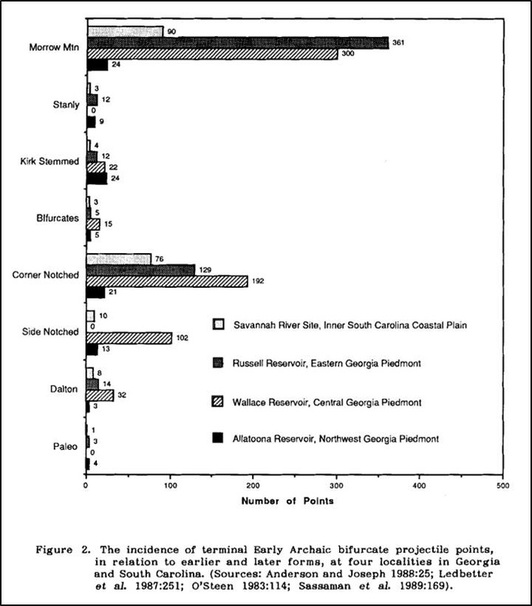
One of those is Ken Sassaman.  I'm currently working my way through his 2010 book The Eastern Archaic, Historicized and finding it fascinating.  Sassaman proposes that the archaeology of the Eastern Woodlands records an abandonment of significant portions of the Southeast at the end of the Early Archaic and a subsequent influx and occupation by peoples with origins outside the region (presumably to the west).  Those intrusive peoples, Sassaman argues, constitute the founding populations of the Shell Mound Archaic phenomenon focused between the Tennessee and Ohio Rivers. They can be recognized by the appearance of stemmed Morrow Mountain points representing a distinct technological break from the lanceolate-notched point tradition which descends from Clovis.
Picture
Image from “The Bifurcate Tradition in the South Atlantic Region” by David Anderson (1991), showing projectile point count data that suggest an abandonment of portions of Georgia and South Carolina during the late Early Archaic and in increase in population associated with the appearance of Morrow Mountain points at the onset of the Middle Archaic.
Several things make this "separate ancestry" idea a really interesting proposition.

​First, as Sassaman acknowledges (pg. 44), migration-based explanations for changes in material culture largely fell out of favor as the adaptation/ecological focus of processual archaeology took the baton from cultural-historical archaeology.  
"Hypotheses for "intrusive" elements or populations at this time [the Middle Archaic] have never been seriously entertained and, since the 1960s, have in fact been ridiculed as nonexplanation."
Not every change in material culture signals the arrival of a "new" people, of course, but in some cases it certainly does, and maybe this is one of those cases.  Sassaman is proposing an influx of populations from the outside as a hypothesis to explain not just the appearance of a new point style, but what we can now recognize as a patterned suite of changes --technological, demographic, and social -- that unfolds across the Eastern Woodlands. His migration explanation is based on far more data than were available in the 1930s and 1940s, and it is launched from a position of much greater theoretical sophistication than the Archaic migration explanations of the past. As he presents it, it fits several differently lines of data and explains some things that explanations wed to in situ ecological change have difficulty with.

Second, the brave new world of theory in which we now operate means that there are potentially many different ways to approach, evaluate, and flesh out the hypothesis of a major migration into the region during the Middle Archaic. Sassaman highlights, for example, some basic contrasts between the behaviors and belief systems of diasporic communities ("those that share a common history but not a common place") and coalescent communities ("those that share a common place but not a common history") and asks how we might understand the record of the Middle and Late Archaic using that lens.  As someone who has spent time wrestling with Archaic lithic technologies, I  like the idea that maybe there are other ways to approach the confusing space-time tangle of projectile point styles and connect changes in that tangle to other aspects of history, process, and interaction.  Diasporic communities, eventful history, and ethnogenesis in the Middle and Late Archaic? Now that sounds like fun.

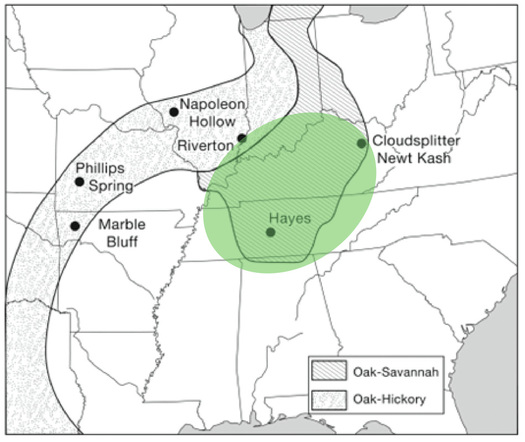
Third, a new framework for examining alternative narratives for the Middle Archaic facilitates a fresh look, I think, at the "bread and butter" questions of intensification and complexification of hunter-gatherer societies in the Eastern Woodlands.  What happens to our explanations of settlement and subsistence change if we can't presume demographic (i.e., biological) continuity through time? Look at Bruce Smith's map (in this 2011 paper) of where the earliest domesticated plant remains have been recovered with the core area of the Shell Mound Archaic superimposed:
Picture
Map from Bruce Smith's (2011) paper "The Cultural Context of Plant Domestication in Eastern North America" with core area of Shell Mound Archaic superimposed (green oval). Cloudsplitter, Newt Kash, Riverton, and Hayes are the sites with the earliest (~3800-3600 calibrated YBP) recovered examples of domesticated Chenopodium.
Although plants such as Chenopodium are not classified as "domesticated" until the Late Archaic period (ca. 3700 calibrated YBP), the processes of domestication began thousands of years earlier, during the Middle Archaic. If Sassaman is correct about population movements into the region during the Middle Archaic, domestication of several key plants may have been associated with populations relatively new to the area rather than as a result of a "settling in" process with roots in the Late Pleistocene.

​Readers of this blog know that I love entertaining so-called "alternative" ideas that run counter to prevailing interpretations but also fit the available evidence. This is a good one.  As I'm reading Sassaman's book (I'm on chapter 4 of 6), I'm finding myself flipping through my internal store of knowledge, opinions, and assumptions about the Midwestern (especially Ohio Valley) Archaic that I know fairly well and the new things I'm learning about the Carolina Archaic. Any book that prompts that kind of reshuffling is, in my opinion, a good book.

There is a great amount of work to be done, and I hope that Sassaman's book stimulates some new thinking about this chunk of time. If you can read through his treatment of regionalized mortuary practices, craft and trade, and mound building and monumentality during the Middle Archaic and not be convinced that this sub-period is not only worthy of much more attention but, when viewed at a macro scales, fascinating . . . you probably haven't read this far into this blog post anyway. Sassaman's book doesn't just dress up the Middle Archaic in a rented tuxedo for the night to make it look good:  it constructs a legitimate re-boot that students of Eastern Woodlands early prehistory should have a look at.

Maybe I can make my next class on the Middle Archaic a little spicier without relying on the Lizard Man. There are a lot of nuts and bolts things that we need to know about how the rhythm and tempo of Middle Archaic life at small scales (hence my interest in finding some well-preserved sites to go along with all of the surface data here). But tying those things into larger sets of questions that move beyond simple ecology (or at least considering a larger range of social and demographic settings in which to situate those ecological questions) can't hurt. Whatever happened in the Middle Archaic happened, and there's no changing that now. It's not the Middle Archaic's fault if we're not smart enough to figure it out. Don't blame the victim. 

I know that some of you follow this blog are professional archaeologists and some are not. I find Sassaman's book to be very readable, but there is some technical content that probably won't appeal to all audiences.  You can find the first chapter here as a pdf if you'd like to have a look.

References
  • Anderson, David. 1991. The Bifurcate Tradition in the South Atlantic Region. Journal of Middle Atlantic Archaeology 7:91-106.
  • Griffin, James B. 1952. Archaeology of Eastern United States. Chicago: University of Chicago Press.
  • ​Sassaman, Kenneth E. 2010. The Eastern Archaic, Historicized. New York: Rowman & LIttlefield.
  • Smith, Bruce D. 2011. The Cultural Context of Plant Domestication in Eastern North America. Current Anthropology 52, No. S4, The Origins of Agriculture: New Data, New Ideas (October 2011), pp. S471-S484. 
The Bison in the Room

2/22/2016

 
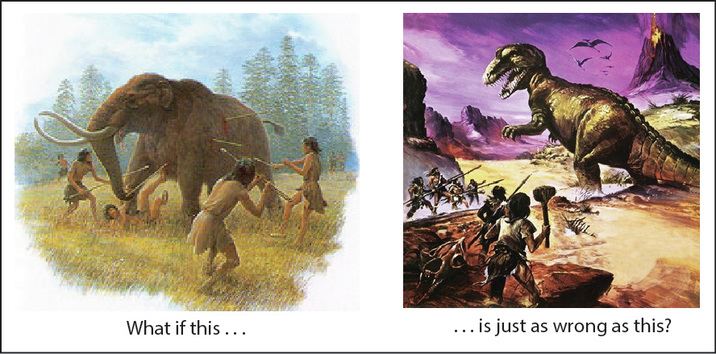
What if the Clovis adaptation in the Eastern Woodlands had nothing substantive whatsoever to do with mammoths and mastodons? 

What if all of those dioramas and illustrations of Paleoindian peoples swarming a mastodon mired in the muck are complete baloney?

What if one of our most popular baseline notions about Clovis in the east is totally wrong?
Picture
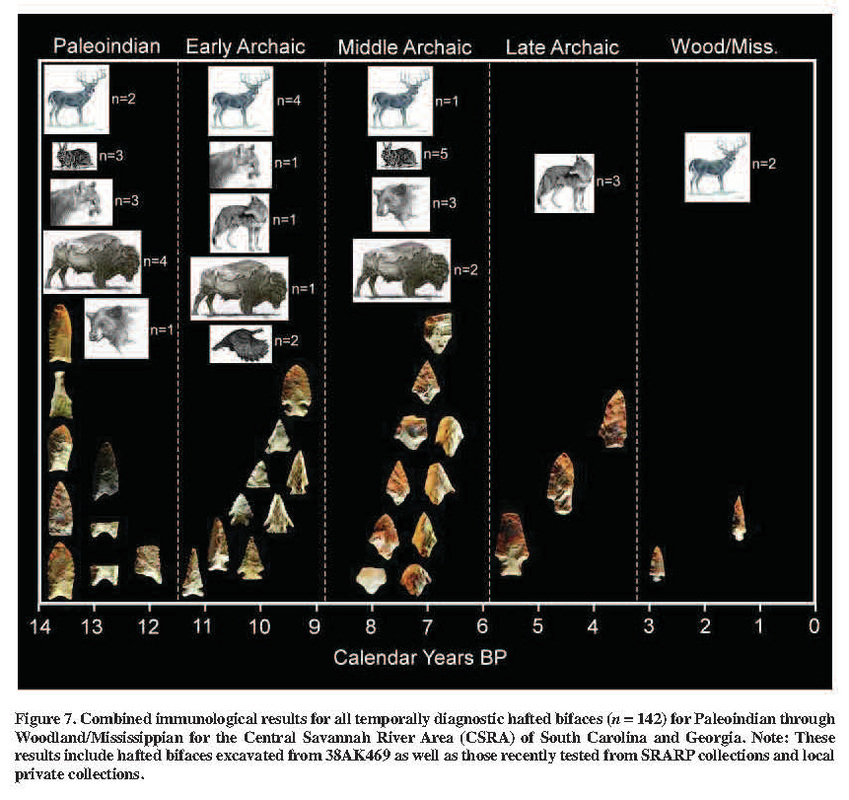
The thought isn't an original one, of course, but one that I've been thinking about since listening to a presentation by Christopher Moore (SCIAA colleague) at the Archaeological Society of South Carolina (ASSC) meeting on Saturday. Moore is the senior author of a recent American Antiquity paper (which is unfortunately behind a paywall) that presents protein residue analysis of 142 hafted bifaces (i.e., stone projectile points/knives) from the Savannah River area of South Carolina and Georgia.  Protein residue analysis uses chemical tests to identify trace residues left on stone tools through contact with the blood of various groups of animals.

Here is a summary figure from the published paper:
Picture
The results that Moore et al. present are striking for two main reasons. First, there is positive evidence for the exploitation of bison in the region during the Paleoindian through Middle Archaic periods.  Second, there are no indications that any of the Paleoindian tools they examined were involved with processing proboscideans (i.e., mammoths and mastodons).

As explained in the American Antiquity paper, the positive evidence for bison populations in the region in the Late Pleistocene is consistent with several other data points (including previous protein residue studies and radiocarbon-dated remains such as the Wacissa bison). The new residue data also support the continued presence of bison in the region into the mid-Holocene. That's pretty interesting to me, as it suggests that the exploitation of a large game animal that is more-or-less invisible in the faunal records (both archaeological and natural) may have been important to the food economies of the Archaic peoples I'm keenly interested in understanding.

And what about the absence of hits for proboscidean?  That's pretty interesting as well. Near the end of his ASSC presentation, Moore informally posed a great "what if" question (and I'm paraphrasing here): what if the evidence for human involvement with mammoths/mastodons in eastern North America actually pertains to pre-Clovis rather than Clovis peoples?

For me, pondering that question was one of those nice "wait a @#!%*$# second . . ." moments that happens every so often in science. What if we have not just exaggerated the embrace between Clovis and megafauna in the east, but allowed our romantic notions (and the very clear evidence of Clovis-age megafaunal predation in the west) to blind us to the real pattern that's present?

Impossible, you say?  Let's ask a series of questions. I'll give you the answers based on what I know off the top of my head and what I have time to assemble on Monday morning of a busy week.  Please correct me if I'm wrong on something or help me add things I've left out -- I'm not making any claim that this listing of evidence is exhaustive. Note: when I say "eastern North America" I mean east of the Mississippi River.

Question: Are there any direct associations between Clovis stone tools and mammoth/mastodon remains in eastern North America?

Answer: No. As far as I know, Kimmswick (Missouri) is the farthest east Clovis-associated megafaunal kill site.

Question: Are there any human-butchered mastodon/mammoth remains in eastern North America that have been dated to the Clovis period (i.e., 11,050-10,800 radiocarbon years before present [RCYBP]; ~13,250-12,800 Calendar years before present; ~11,300-10,850 BC)?

Answer: Not that I know of off the top of my head. The eastern cases of purported mastodon/mammoth butchery of which I am aware pre-date the known age range of Clovis. Here are some examples:
  • Hebior mammoth (Wisconsin): ~12,500 RCYBP;
  • Burning Tree mastodon (Ohio): ~11,500 RCYBP (Fisher et al. 1994);
  • Aucilla River mastodon tusk (Florida): ~12,200 RCYBP;

Question: Is there any direct evidence that mammoths/mastodons survived into Clovis times in eastern North America?

Answer: Yes. There are directly-dated mammoth and mastodon remains that demonstrate that proboscideans survived into and beyond Clovis times. The period 10,500-10,000 RCYBP (i.e., post Clovis) is probably a reasonable extinction window for mastodons in the east.  Here, for example, is a report of a mastodon from northern Indiana dated to about 10,000 RCYBP. 

Question: Is there any direct evidence that Clovis peoples used parts of mammoths/mastodons obtained from recently deceased animals?

Answer: Yes, apparently. There are ivory and bone tools from Florida that are attributed to Clovis. Here is a quote from a paper by Bruce Bradley:
"While most of the known specimens were recovered from stratigraphically mixed deposits, recent archaeological excavations have found them in late Pleistocene deposits directly associated with extinct fauna, including mammoth and mastodon. Flaked stone projectile points and other tools are also associated with these artifacts. Projectile point types commonly include Clovis fluted and Suwanee."
​I don't have the time to delve into the literature right now and investigate the nature of the associations between the ivory tools and the Paleoindian points, or to see if any of the ivory tools have been directly dated. 
So there you go.

It seems pretty clear that Clovis peoples existed on the landscape (or were at least present in eastern North America at the same time) as proboscideans.  They apparently used parts of those animals to fashion tools. But the case for active Clovis-age predation of mammoths and mastodons continues to be based on circumstantial evidence. As more and more purported proboscidean butchery sites of pre-Clovis age are reported from the Eastern Woodlands, it seems less likely that the east-west contrast in megafaunal kill sites is solely the result of a preservation bias: it's not the elephants that are missing, but the direct evidence that Clovis peoples hunted them.

If we take mammoths and mastodons out of the Clovis picture, there's a lot of explaining to do. What was the point of all that beautiful technology? I was one of several junior co-authors on a paper (Speth et al. 2013) that attempted a political re-imagining of Early Paleoindian fluted point technologies. While I'm not convinced by all the arguments in that paper, I think it was a useful exercise. There are other alternatives to the dominant "Clovis meat machine" model that can be constructed.

And what if bison was an important game animal in some portions of the Eastern Woodlands into the Middle Archaic? What if bone preservation issues really are part of the problem for our interpretations of the Early and Middle Holocene and we've been unable to see (and therefore to factor into our models) a large herbivore that may have been a huge part of the subsistence economies of early hunting-gathering societies in the region? That deserves a very hard look.

I've used all the time I can spare to write about this today. I'm hoping some of you find this question interesting and point out things I'm not aware of. I'll be returning to this as I have time - it's a pretty cool set of questions to think about. 

ResearchBlogging.org
Moore, C., Brooks, M., Kimball, L., Newman, M., & Kooyman, B. (2016). Early Hunter-Gatherer Tool Use and Animal Exploitation: Protein and Microwear Evidence from the Central Savannah River Valley American Antiquity, 81 (1), 132-147 DOI: 10.7183/0002-7316.81.1.132

Kirk Project Presentation at the ASSC Meeting

2/20/2016

 
Picture
Today I'll be giving a short presentation at the annual meeting of the Archaeological Society of South Carolina. Being a new transplant to South Carolina, this will be my first time attending the meeting. I'm looking forward to meeting my new colleagues from around the state and hearing about what they're working on.

I decided to talk about the Kirk Project at today's meeting. Although I've been working on it steadily over the last few weeks, my energies so far have been channeled into prepping the database and streamlining the process for producing 3D models.  So, unfortunately, I don't yet have any coherent data or analysis to present. My presentation is an informal discussion of the question of the Kirk Horizon and what we can do to address it.

Here's a pdf of the slides I'll be talking from today.  Unfortunately I ran out of time to provide complete citations for the parenthetical references.  I'll fill those in and provide a complete version later. 

Submitting Data to the Kirk Project

2/12/2016

 
I've been working on laying the groundwork for the Kirk Project.  I've created a new "Kirk Project" page to organize my various blog posts on the subject as well as house a list of the 3D models I've created and the the current distribution map of the sample (I've also created a sub-page just for the models).  I've also prepared some guidelines for submitting data.  Here they are (and here is a pdf file of the same information):
The Kirk Project
Data Submission Guidelines (2/12/2016)
The Kirk Project is an online initiative to assemble a pan-Eastern dataset of primary data about projectile points associated with the Early Archaic “Kirk Horizon” (dating to about 8,800-6,600 BC).  The Kirk Horizon is marked by a distribution of Kirk Corner Notched points that extends across a huge area, from the lower Great Lakes to the Florida Keys. Its existence has been noted for over four decades (i.e., at least since James Tuck’s 1974 paper “Early Archaic Horizons in Eastern North America”).  There has never been a concerted effort to assemble a dataset of sufficient detail and spatial scope to allow us to characterize and analyze the kinds, amounts, and spatial components of variability among these points. The goal of the Kirk Project is assemble such a dataset.

What Information is Useful?

In order to be useful to the project, information about Kirk points must have at least two components:
​
  • at least a county-level provenience;

  • scaled visual or virtual representation (i.e., a scaled photograph or a 3D model).

If we don’t know where it came from and/or we can’t pull size/shape data from it, the information will be of very limited usefulness to the project and, in my judgement, not worth including. 

The presence of a third piece of information (lithic raw material) is highly desirable but not necessary for inclusion.

NOTE: incomplete/broken points are still useful as long as they retain enough diagnostic characteristics to be lumped into a broad “Kirk” category. If you can tell it’s a Kirk and you know where it came from, chances are that it retains some measurable/classifiable features that would be useful to know about.

A Brief Description of the Database

The main database for the Kirk Project will be a continuation of the relational database I used to record points in northern Indiana and, later, for my dissertation.  Each point in the database (Kirk or otherwise) gets a unique ID number that makes it distinct from all other points. 

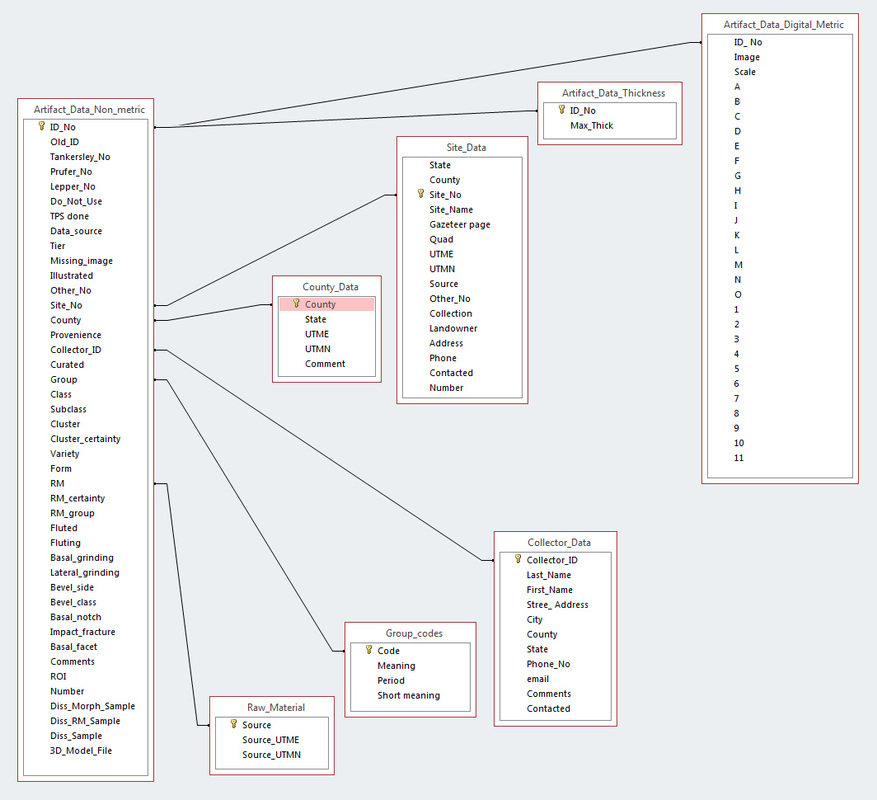
The database includes a variety of tables that are linked together (see figure). The main table is “Artifact_Data_Non_metric.”  This table stores the basic information about the point including ID number, other associated “external” numbers (i.e., assigned in collections or publications), general typological classification, raw material, county-level provenience, and some basic non-metric attributes (presence/absence of basal grinding; presence/absence of beveled blade edges, etc.).

As shown in the diagram, several of the fields in “Artifact_Data_Non_metric” link to other tables.  The field “County” links to a table containing the approximate UTM coordinates of the center of the county. The field “ID_No” links to a table containing metric data that I derived from artifact images (for my dissertation).  The structure of the database will undoubtedly change as the project develops.
Picture
The full database contains some information (such as site-level coordinates and information about personal collections) that will not be made publicly available. 

To make the primary data accessible and usable, I will design a query to produce a dataset containing all the Kirk points in the database by unique ID number. Information for each point will include, minimally, other identifying numbers, county-level provenience (and associated UTM coordinates), raw material information, non-metric attributes, available metric data, and links to 3D models if available. I’ll have to figure out how to store and make accessible online all the images that will accompany a spreadsheet of the data.

How Do I Submit Data?

2D Image submission: Each point submitted must be represented by a good-quality, plan view photograph of the point accompanied by a metric scale. Please name the image files with your last name and unique, sequential numbers (for example, Joan Smith submits images of three Kirk points and labels them “Smith 1,” “Smith 2,” and “Smith 3”). 

3D model submission: Points submitted as 3D models should be numbered the same as images (for example, Joan Smith submits models of three Kirk points that are different than those in the images she submitted and labels them “Smith 4,” “Smith 5,” and “Smith 6”).  Save models in STL format.

Both regular 2D images and 3D models should be accompanied by a spreadsheet or table that lists the images/models by their filenames and provides the following information:
Picture
  • Image Name: the file name of the image.
  • County: The county with two-letter state/province abbreviation appended.
  • Site Number: Smithsonian trinomial site designation or Canadian site number.
  • Other Numbers: Numbers assigned for museum curation, other analyses, publication, etc.  Knowing these numbers will help us avoid including the same point more than once.
  • Curated: Where is the point currently kept?
  • Raw Material:  The lithic raw material of the point, if known with a high degree of confidence. If you suspect a certain raw material but have doubts, add a “?” at the end.
  • Basal Grinding:  Score the presence of grinding along the basal edge as “present” or “absent.”
  • Bevel side: Does the point have beveled blade edges?  If so, indicate if the bevel is visible on the left-hand side (LHB) or right-hand side (RHB) when you look at the point with the tip pointed up. If the point is not beveled, leave blank.
  • Bevel class: If the point is beveled, classify the degree of beveling as either “bevel” (there is a strong boundary line between the resharpened edge and the original blade surface that creates a diamond-shaped cross-section) or “twist” (asymmetrically resharpened, but no strong boundary line).
 
Where Do I Send Data?
​

Email your 2D images and spreadsheets to Andy White: [email protected].

To transfer 3D models, use an upload/display/download service like Sketchfab (www.sketchfab.com). Sketchfab lets you upload models < 50 MB for free.

The Kirk Project: The Nipper Creek Cache

2/5/2016

 
Don't worry -- I'm not planning on writing about every Kirk point I look at. I've gained some new readers with the whole "Roman sword" debacle, and I hope to not lose all of them as I transition back into writing more about real archaeology and anthropology. Neither the real science nor the stupid ever stops, but I'll try to mix it up somewhat.
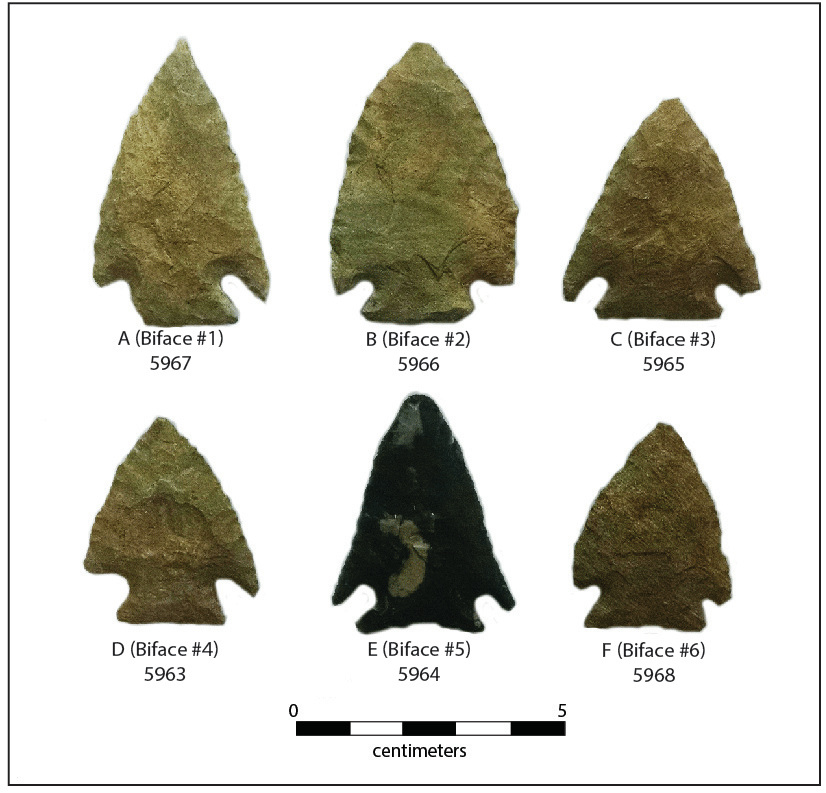
I wanted to write a quick post about a small (n = 6) assemblage of Kirk points from the Nipper Creek site (38-RD-18) in Richland County, South Carolina.  The six points were part of a cache that was exposed during a 1986 archaeological field school directed by Albert Goodyear and Ruth Wetmore. (For those unfamiliar with the archaeological use of the term, a "cache" is a group of objects that were hidden or stored for future use.)  The six points were found within a small horizontal area (about 264 square cm, a little over a quarter of a square foot) and within about 5-10 cm vertically.  It is likely that the points were originally placed in a pit (no outline of a pit was discerned) or on a common surface.

Goodyear et al. described the Nipper Creek cache in a short 2004 paper in Current Research in the Pleistocene (see reference below).  I took the opportunity to take a quick color photo of the points as I was scanning them so I could have a visual record cross-referencing the alphabetic designations used in the Goodyear et al. paper with the numeric designations on the bags and the unique ID numbers assigned to the points in my database. 
Picture
Kirk points in the Nipper Creek cache. All except E were made from metavolcanic stone from North Carolina. Point E was made from Ridge and Valley chert, probably obtained in eastern Tennessee.
One really useful thing about an assemblage like the Nipper Creek cache is that it gives us a "snapshot" view of tools from a narrow window of time. Because these six tools all entered the archaeological record together, transferred from a "dynamic" human behavioral context to a "static" archaeological context in a single act, they can potentially tell us something about synchronic variability in Kirk Points that "broad time" surface assemblages cannot. At least some of the variability in Kirk has to be related to change through time -- how do we pin that down? With the aid of stratified deposits and discrete features that provide context.  "Narrow time" deposits like the Nipper Creek cache are potentially of great utility in interpreting the variability that will be present in a "broad time" assemblage of Kirks from across the Eastern Woodlands.

Goodyear, Albert C., William Radisch, Ruth Wetmore, and V. Ann Tippitt.  2004.  A Kirk Corner-Notched Point Cache from the Nipper Creek Site (38RD18), South Carolina.  Current Research in the Pleistocene 21:42-44.

Update (2/11/2016): 3D model of Biface 3 (5965) completed.
​Update (2/12/2016): 3D model of Biface 2 (5966) completed.
Update (2/15/2016): 3D model of Biface 5 (5964) completed.
Update (2/16/2016): 3D model of Biface 4 (5963) completed.
​Update (2/18/2016): 3D model of Biface 1 (5967) completed.
Update (2/19/2016): 3D model of Biface 6 (5968) completed.

The Kirk Project

2/4/2016

 
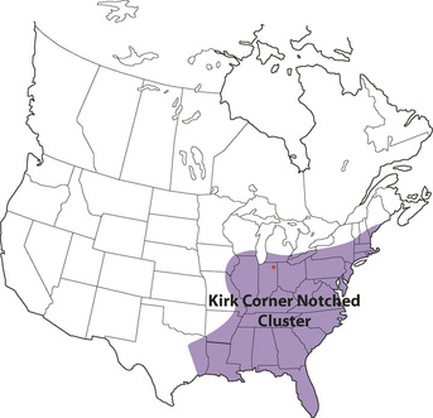
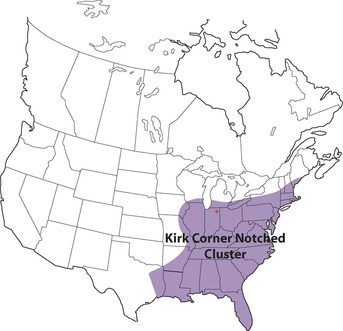
PictureDistribution of Kirk Corner Notched cluster projectile points (adapted from Justice 1987).
Last Thanksgiving break, I wrote this post about the Early Archaic corner-notched point horizon in the Eastern Woodlands, discussing some of the things we know and pondering some of the questions we can't currently answer. As a refresher, the “Kirk Horizon” (dating to about 8,800-6,600 BC) is marked by a distribution of Kirk Corner Notched points that extends across a huge area, from the lower Great Lakes to the Florida Keys. Its existence has been noted for over four decades (i.e., at least since James Tuck’s 1974 paper “Early Archaic Horizons in Eastern North America”).  

Although many authors have remarked on the striking similarity of Kirk Corner Notched projectile points from across the east, as far as I know there has never been a concerted effort to assemble a dataset of sufficient detail and spatial scope to allow us to characterize and analyze the kinds, amounts, and spatial components of variability among these points. Given how widespread Kirk is, that's a big job.

I assembled a relatively large dataset of Kirk points from the Midwest as part of my 
dissertation work, and have used that information in a couple of publications (e.g., this one and this one).  I've now started the process of adding to that dataset, beginning with information from Kirk points in large collection from Allendale County, South Carolina, that was donated to SCIAA in the 1990's.  I'm working my way through the Kirk Cluster points in that collection, adding them to my existing database and producing 3D digital models. 

Picture
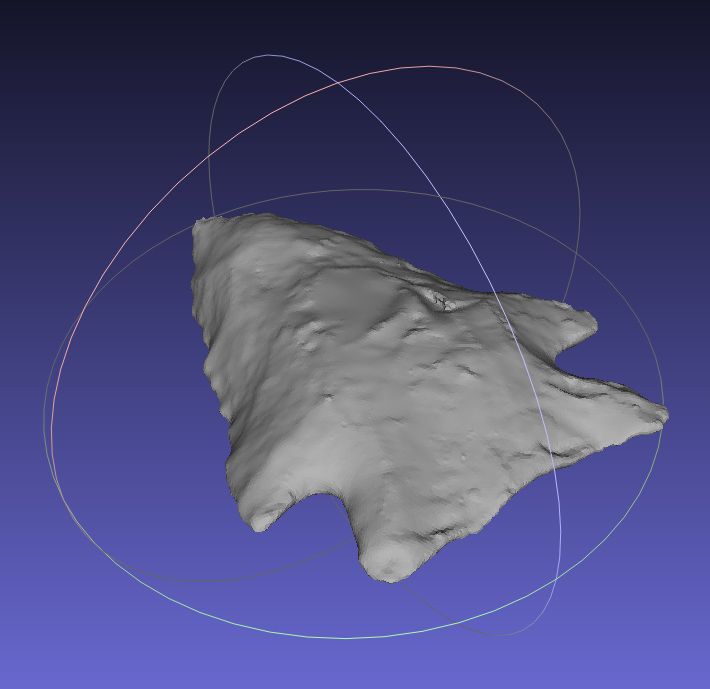
A 3D model of a Kirk point from Allendale County, South Carolina. You can see the smooth facet in the middle of the blade - that's created by the hole left by the little gripper doo-dad I'm using to hold the point for scanning. Holding the points in the middle exposes all the edges which are important for measurements. The smooth spot is annoying, however.
Second, I need to work up a battery of replicable measurements that I can take on the 3D models that will capture aspects of functional and/or stylistic variation. That's going to require learning new software (I'm currently looking at MeshLab, a free product) and doing some thinking about what makes sense.  Using 3D models gives you the opportunity to do things you can't do with calipers, such as examine size/shape of a cross-section positioned anywhere on the point, accurately calculate volume and surface area of portions of the point (just the haft portion, for example), quantify arcs and curves, etc. Figuring out what information I want to extract and how I can extract it will be an iterative process. 
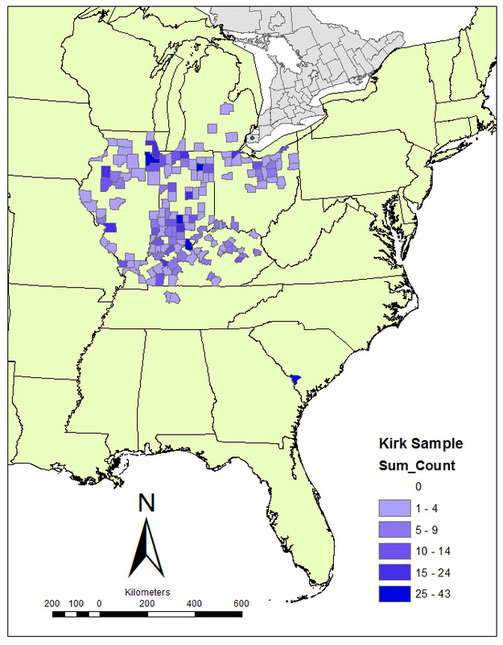
PictureSpatial distribution of Kirk sample by county as it currently sits in my database (889 points total).
The Eastern Woodlands is big. It took me years of intermittent work with both private and institutional collections to assemble my Kirk dataset from the Midwest.  It's going to take me a while to build a dataset of similar size in the South Carolina and the adjacent Atlantic Coast states.  As you can see from the map, I have no data from the deep south or the Northeast.  

If you're like me and are interested in questions about Kirk (including where it comes from and what it can tell us about the Early Archaic societies of the Eastern Woodlands), I ask you to think about the idea of producing the largest-ever Kirk dataset ever assembled. How similar are Kirks, really, across this large area? How does variability within Kirk break down according to space? Can we identify regional differences in "stylistic" variation?  Are there discontinuities or is variability clinal? What about regional differences in the scales of raw material transport? Is morphometric variability isomorphic with lithic raw materials? Can we identify regional variation in "functional" attributes such as resharpening patterns, haft size, blade configuration, etc.?  Just from looking about the first 30-40 Kirk points I've examined from South Carolina, I'm guessing there might be a higher incidence of beveling (all left hand beveling so far) here than in the Midwest.

Anyway, this post isn't supposed to be high pressure. I won't necessarily be able to devote a great deal of time to this on any given day. I'm just letting you know that if you're interested in Kirk and want to think big, I'm right there with you. Let me know if you want to participate in an effort to create a massive Kirk dataset that we can use to address all kind of potentially interesting questions about early Holocene hunter-gatherers in the Eastern Woodlands. Please pass it on to anyone you think might be interested.


Update (2/12/2016): Guidelines for contributing data to the Kirk Project.

Early Eastern Hunter-Gatherers and Holiday Travel

11/24/2015

 
If you’re like me, there’s always some part of your brain that is thinking about hunter-gatherers.  Sometimes when I’m at work the percentage can get as high as 95 percent.  Most of the time it’s lower, of course, but it never gets down to zero. I’m always on duty.

Yes, I just said that with a straight face. And yet I'm a surprisingly poor poker player.
Picture
Columbia, South Carolina, November 2015.
Picture
Ann Arbor, Michigan, November 2015.
Over the last few days, I’ve travelled by car, air, and then car again to get from South Carolina to northern Georgia, Georgia to central Indiana (that was the air leg), then central Indiana to southeast Michigan.  The purpose of the trip is to see family over the Thanksgiving break.  But it also served up a reminder of the nature of seasonal differences in environment across the Eastern Woodlands.  As a recent transplant from the Midwest to South Carolina, my seasonal clock is still adjusting: how can the semester be coming to a close when I’m still gardening in a short sleeve shirt?  Seeing my breath on the jetway after landing in Indianapolis nudged my seasonal clock forward; the drive north to an Ann Arbor blanketed in snow finished off the reboot.  

The quick transplantation back to Ann Arbor made me ponder how hunter-gatherer societies would have handled regions of the Eastern Woodlands with such contrasts in the character, severity, and potential suddenness of seasonal changes.  Just as Midwesterners today have to employ a set of behavioral and cultural strategies to deal with winter that is quite different from those necessary to survive the occasional day in Columbia when the temperature dips below freezing, there is no way that hunter-gatherers in the temperate Great Lakes could spend the winter doing the same things as hunter-gatherers in the sub-tropical Carolinas.   This is not a profound idea, of course:  hunter-gatherers have to deal with the characteristics of their environments in very direct ways, and whatever the particular social, cultural, and behavioral characteristics of a hunter-gatherer system, those characteristics have to allow the system to “fit” within its environment.  Environment isn’t everything, but it’s important.
One of the interesting things about the hunter-gatherer archaeology of the Eastern Woodlands is that, for some chunks of early Holocene prehistory, some aspects of material culture appear to be amazingly uniform across vast regions of space.  An Early Archaic “Kirk Horizon” (dating to about 8,800-6,600 BC) is marked by a distribution of Kirk Corner Notched points that extends north-south from the southern Great Lakes to the Gulf Coast and east-west from the Mississippi corridor to the Atlantic.  That's a big area.  
PictureDistribution of Kirk Corner Notched cluster projectile points (adapted from Justice 1987).
And not only does this initial "horizon" emerge in the context of what by all appearances are very thinly distributed, highly mobile hunter-gatherer populations, but projectile points styles seem to change in lockstep across this same region of North America for at least some time after.  How can we explain this?  Although lithic raw material data suggest that Kirk groups were highly mobile (e.g., see this paper) the area of the "horizon" is much too large for it to be the product of a single group of people: the hunter-gatherers discarding Kirk points in Ontario are not the same individuals as those discarding Kirk points in Florida.

But that doesn't mean they weren't part of the same society.  We can define a "society" as a population defined by the existence of social ties among and between groups and individuals.  Ethnographic hunter-gatherers have numerous mechanisms for creating and maintaining social ties (e.g., marriage, exchange, group flux, periodic aggregation), and there is no reason to suspect that all of those same behaviors were not utilized to knit together the social fabric of early Holocene hunter-gatherers in the Eastern Woodlands.  Maintaining social ties that extend beyond "over the horizon" may be especially important to high mobility hunter-gatherers operating at low population densities, as such ties allow local populations to gather information about large areas of the landscape.

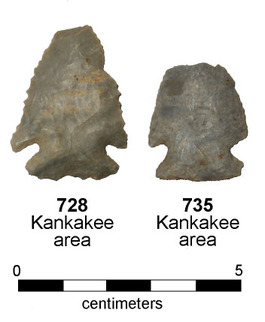
PictureA couple of Kirk cluster points from northwest Indiana.
So maybe the apparent uniformity of lithic style that we recognize as the Kirk "horizon" emerged as simply the unintentional product of the presence of a continuous, "open" social network that stretched across the Eastern Woodlands. That's a logical possibility. Demonstrating that such an explanation is plausible, however, is a multi-faceted problem.  

First, you need data that actually let you characterize the degree of variability in the Kirk Corner Notched cluster and how that variability breaks down with regard to space (and raw material use). Given how widespread Kirk is, that's a big job.  But it's a doable job with the right commitment: Kirk points are common and fairly easy to recognize (they really are remarkably similar in different parts of the east, at least the ones I've looked at). I started working on assembling a Kirk dataset from the Midwest as part of my dissertation work and grant work while I was at IPFW.  I'm going to continue that work down south: I've applied for some grant money to start working on inventorying and collecting data from a large collection of points from Allendale County, South Carolina, and there are numerous other existing collections available.  My plan is to create 3D models of the points as I analyze them, which will aid in both morphometric analysis and data sharing. I don't think I'll have to create the whole Kirk database myself (see this post about 3D modeling of points from the Hardaway site in North Carolina). 

Second, it's a modeling problem.  How much interaction across a social landscape the size of the eastern United States would be required to produce and maintain the degree of stylistic uniformity that we see? You can't answer that without a model that lets you understand how patterns of social interaction might affect patterns of artifact variability (run-of-the-mill equation-based cultural transmission models won't cut it, either, because they typically don't take spatially-structured interaction into account).  I started to try to tackle that question in my dissertation and with some other modeling work. The simple assumption that the degree of homogeneity would be proportional to the degree of interaction is probably wrong: network theory suggests to me that a nonlinear relationship is more likely (a small degree of interaction can produce a large degree of homogeneity).

Picture
Finally, circling back to the beginning of the post, we need to have some understanding of environmental variability across the Eastern Woodlands and the implications of that variability in terms of the hunter-gatherer societies that dealt with it. While there are some environmental commonalities in terms of plants and animals that help unify the Eastern Woodlands as a single macro region (and a “culture area” throughout prehistory), it's obviously not all the same.  Seasonal differences in the weather would not only affect human behaviors directly, but indirectly through their effects on primary game species such as white-tailed deer. I'm not a deer hunter or a wildlife biologist, but the contrasts between the modern deer-hunting practices and laws in Midwestern states (e.g., Ohio, Michigan, Indiana) and in South Carolina are striking in terms of the length of season, the bag limits, etc. While I'm sure that modern history, culture, and land-use play some role in these differences, I would be very surprised to find that environmental differences don't contribute significantly to the amount of hunting that deer populations can bear in these different regions.

Significant differences in the density and behaviors of deer populations would have had implications for the hunter-gatherer populations that exploited them, perhaps especially during the Fall and Winter.  I would guess that variability in deer populations and behavior vary continuously across the Eastern Woodlands along with other aspects of environment (temperature, mast production, etc.). Different strategies, perhaps involving patterns of seasonal mobility and aggregation, would have surely been required in the far north and far south of the region. Whatever the components of those differences, however, they were apparently not sufficient to produce hunter-gatherer societies that were disconnected on the macro level during the Early Archaic period. It may be the case, in fact, that differences in seasonality across the region, in a context of low population densities, actually encouraged rather than discouraged the creation of an "open" social network that resulted in the emergence of the Kirk Horizon. Later on in the Archaic we do indeed see a regionalization of material culture that makes the Midwest look different from the Southeast.

Whatever the characteristics of their larger social networks (and smaller social units within those networks), those Early Archaic societies provided a foundation for much of the Eastern Woodlands prehistory that follows. It's going to require theory-building and a lot of data from a large area to understand it. We need some kind of Kirk Manhattan Project.

The Topper Site Pre-Clovis: A Newcomer's Perspective

11/5/2015

 
Yesterday I had the pleasure of visiting the Topper site with my SCIAA friend and colleague Al Goodyear.  In addition to ongoing work on a well-preserved Clovis component (e.g., see this page by Derek Anderson and this 2010 paper by Ashley Smallwood), Topper is probably most widely known for Goodyear's claim of evidence for a human occupation possibly in excess of 50,000 years old. For those of you keeping score at home, that is significantly older (by tens of thousands of years) than the proposed dates for other pre-Clovis components in eastern North America. Good evidence for a New World human occupation that old would really be a game changer.  And that's why Topper is controversial. And interesting.
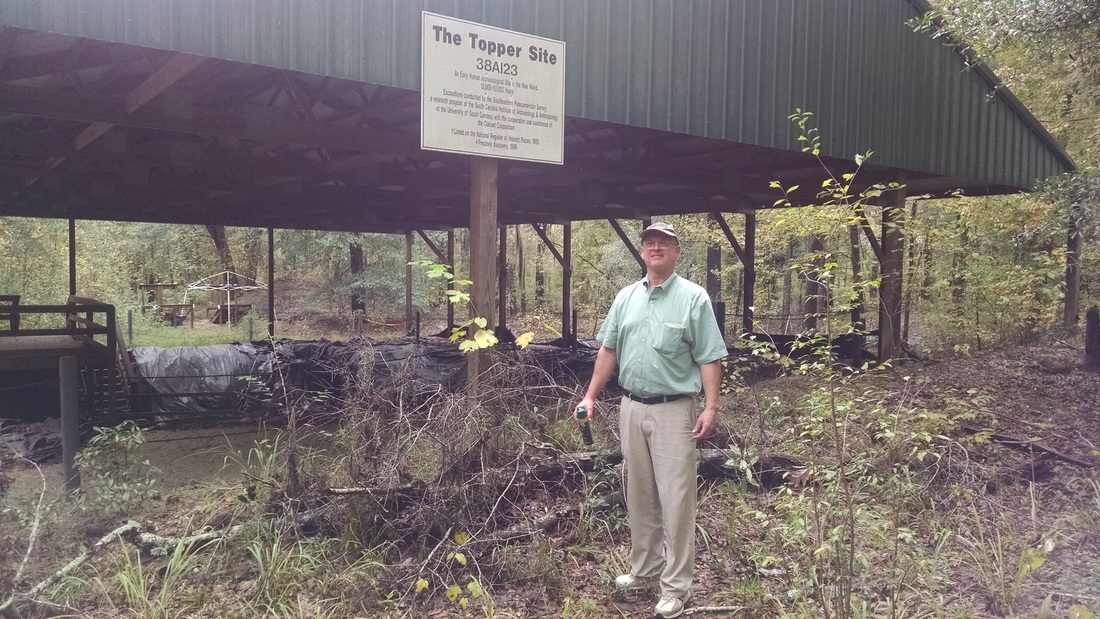
PictureAl Goodyear in front of the deep excavation area at the Topper site. The mosquitoes were very happy to see us.
The purported pre-Clovis assemblage from Topper is entirely stone, consisting of items described as cores, blades, flakes, gravers, spokeshaves, scrapers, etc. Bifaces are absent, which, I think, is one of the aspects of the assemblage that gives many North American archaeologists pause. You can see images of some of the pre-Clovis material here and in Doug Sain's dissertation (discussed more below). You can also read Goodyear's 2009 update on work at the site here.

The questions about the Topper pre-Clovis assemblage boil down to two main issues:

  • Is the material cultural?
  • Is it really that old?

Both of those issues are much simpler to raise then they are to answer.  

Is It Cultural?

The "is it cultural" question is Question Number 1: if it's not cultural, then it doesn't really matter how old it is. Some archaeologists (such as Michael Collins in this Popular Archaeology article and this CNN story)  have stated that the the pre-Clovis materials from Topper are the result of some natural process rather than the products of human behavior (i.e., they're "geofacts" rather than artifacts). If the Topper pre-Clovis "artifacts" are just a bunch of rocks, the rest of the story doesn't really matter.

Yesterday I looked at some of the material from Topper that is displayed at USC's Salkehatchie campus. I wasn't doing a systematic analysis, and I didn't actually handle the material (I was just looking through the glass like everybody else), so I'm not yet ready to offer a strong opinion of my own.  I will say, however, that at least some of the objects displayed surely looked like good candidates for human-made stone tools and cores to me. There were several pieces that appeared to have fairly clear unifacial retouch, one flake with a very clear bulb of percussion, large "cores" that appeared to have multiple flake removals, etc.

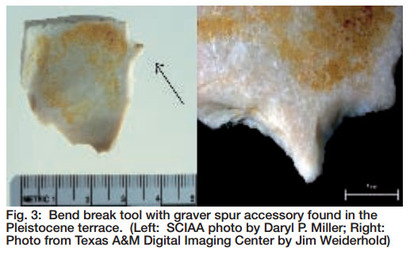
PictureOne of the pieces on display at the USC Salkehatchie campus: a graver from the pre-Clovis deposits at Topper. The image is from Goodyear's (2009) paper (link in the text).
In my opinion, several of the pieces from the Topper pre-Clovis assemblage that I saw (the only ones I've looked at recently) show characteristics that appear to be consistent with human manufacture. Does that mean they couldn't have been produced by some sort of natural process? Good question. Doug Sain's recent (2015) dissertation on the pre-Clovis assemblage from Topper attempted to address that issue by developing several lines of analysis (experimental archaeology, attribute analysis, refitting, etc.).  Sain concluded (on page 567) that:    

"Evidence from this study supports King’s (2011) findings and demonstrates a human origin for the pre Clovis conchoidal flake assemblage at the site. However, this assemblage likely resulted from flake core and flake tool manufacture as opposed to biface manufacture and furthermore does not reflect bioturbation as an agent responsible for deposition. The assemblage is at minimum 14,000 BP and possibly much older. The bend break assemblage from the Lower Pleistocene Sands and Upper Pleistocene Terrace at Topper are also considered products of human agency based on the presence of specific technological attributes (compression rings, lips), retouch modification, and lack of differentially weathered scars." 

I confess that I have only skimmed through Sain's dissertation at this point (it is 2400 pages).  It's clear, however, that he's done a lot more than simply look at some pieces of stone and say "yup, looks like an artifact" or "nope, doesn't look like an artifact." He has looked more closely at the material than (I would guess) anyone else at this point.  Thus his conclusions are an important data point suggesting that we shouldn't be so quick to dismiss the materials from Topper just because they are difficult to reconcile with the "knowns" of North American prehistory.

Is It Really That Old?

If the pre-Clovis materials from Topper are legitimate products of human behavior, can they really be 50,000 years old?

It looks to me like there is little question that the sediments (writ large) from which the Topper materials were excavated really do date to several tens of thousands of years ago.  This (2009) paper by Michael Waters et al. discusses the geoarchaeology and dating of the Topper sediments, if you want to wade into the particulars.

Even if the general sediment stratigraphy is understood and well-dated, however, it is fair to ask if younger artifacts might have been introduced into older sediments through some sort of natural process - tree roots? animal tunnels? cracks in the earth?  I wasn't present at any of the Topper excavations, so I can't really add anything about the possible role bioturbation might have played in moving artifacts around. Again, there is discussion in Sain's dissertation about whether some kind of bioturbation could explain how much younger (i.e., Clovis age) artifacts were introduced into such old sediment.

What If?

Healthy skepticism is an important part of doing good science. I'm as skeptical as the next person, and I think the extraordinary nature of the claims being made about Topper warrant significant scrutiny.  What I (and many others, I think) are anticipating is the definitive publication by Goodyear that lays out the evidence and the argument in a succinct, clear way.  That will let us evaluate the totality of the claim and find a path forward for future inquiry.  The Topper site is still there, and new excavations could be conducted to target questions that develop from analysis of what has been done so far.

But take off the skeptic's hat for a minute and put on the "what if" hat: how cool would it be if there was an archaeologically-recognizable occupation of eastern North America pre-dating the Last Glacial Maximum? Where did those people come from? What were their societies like? What happened to them? Humor me for a minute here.

The time period between about 60,000 and 30,000 years ago (i.e., the time period that is claimed for some of the pre-Clovis materials from Topper) saw the movements of human groups into several previously-unoccupied parts of the world, including northern Asia, Japan, and Australia. What if an early wave of colonizers reached the New World? What if the 33,000 year-old remains from Monte Verde (Chile) were left behind by people in this first wave? What if the 48,000-32,000 year-old remains from Pedra Furada (Brazil) were also left by those early settlers? What if the stone tool technologies of these early settlers, like those of many Paleolithic groups in the Old World, were not based heavily on bifaces? What if a lack of formal bifaces in these early pre-Clovis technologies means that the lithic tools and debris left behind by these early settlers is "hiding in plain site," the nondescript assemblages of pre-Clovis flakes and unifacial tools blending in with the lithics left by much later peoples?  What if that earliest occupation was ultimately unsuccessful, leaving behind no survivors and presenting no evidence for a historical connection between the technologies of its people and those of the people who followed?

That's a lot of "what ifs," but I think that's okay.  "What ifs" are free.

If the pre-Clovis lithics from the Topper site were really produced by a very early human occupation of eastern North America, there is quite a story that remains to be told in this part of the world. And if that story is true, maybe Topper won't even be the site that can tell it the best. If there were people in the Southeast 50,000 years ago, it will ultimately be possible to find other examples of sites that they produced.  Perhaps a systematic look at buried deposits predating the LGM will help produce some information (positive or negative) that can help us understand what Topper means.  After visiting Topper and having a cursory look at some of the materials myself, I'm looking forward to watching the debate play out and seeing what happens next. Who knows -- I may get in on the action myself someday.  

Wanted . . . and Found!  The Buried Archaic Archaeology of South Carolina

10/29/2015

 
During my first couple of months in South Carolina, I've been working to develop a plan for my research here and to move quickly on getting it going.  An important component of what I plan to do involves identifying Archaic Period (ca. 8000-2000 BC) deposits with enough integrity to extract information relevant to understanding the behaviors and decisions of families and small groups. That means finding sites with features and artifact scatters that haven't been deflated, truncated, and chewed up by agriculture, logging, erosion, etc.

​A desire to find intact deposits and the contextual information they offer underlies a lot of archaeology. You can do plenty of interesting and useful things with artifacts and sites that don't have that kind of information, of course, but there are some questions that you really can't ask of surface assemblages of projectile points or flake scatters that are contained completely within the plowzone.
There are several different kinds of landforms in this part of the country that have good potential to contain well-preserved Archaic occupational deposits: sand dunes, rockshelters, near-shore islands, and overbank deposits built by river flooding.  Those overbank deposits (specifically long, linear, sandy natural levees) are where I started my search, and that search has already paid off.
Picture
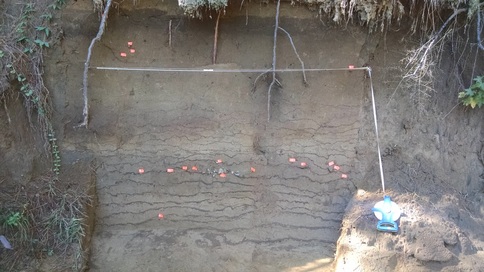
The photo to the left shows a profiled section (about 2 m wide and 2.3 m deep) of the interior of a levee that my colleague Al Goodyear took me to look at last month.    At some point in the not-too-distant past, someone had machine-excavated some sediment out of the side, exposing a more-or-less vertical section perhaps 8-10 m long. Even with a rain-washed and slumped surface, cultural material was visible in several locations. At least two possible pit features were visible, and there was a cluster of lithic debris deep in the profile.

The landowner, generous enough to let us on the property to begin with, was excited about what we saw and agreed that I could go back and do some work to clean and document the profile. I returned to the site last week and worked on the 2 m section shown in the photo.  The pieces of orange flagging tape mark the locations of in situ cultural materials in the wall.  The deep zone with most of the artifacts (most of which are quartz debris) is slightly darker than the sediment above and was (I think) probably formed during an occupation of the levee some 6000-5000 years ago. That guesstimated date comes from the single diagnostic artifact recovered so far: a Middle Archaic Guilford point. The point, also of quartz, wasn't found in the wall but came out of the slump (screened) immediately in front of the wall. I think it probably came out of the artifact zone and therefore probably dates that zone to the Middle Archaic. If the point fell out of the wall from higher up, however, that means that the artifact zone pre-dates the Middle Archaic (which would also be awesome).  It's a win no matter how you slice it. And the whole deposit is sand. That's a win-win.  Or maybe even a win-win-win.


Weather permitting, I'll be back out at the site tomorrow to try to grab another 2-3 meters of profile.

I think there are tremendous and varied possibilities for excellent research at places like this, and I'm pretty happy to have been directed to a site with such obvious potential so soon after I got here. I owe a big thanks to Al and to the landowner for making it happen. Stay tuned!

Lomekwi  3 and the Invention of Technology

6/5/2015

 
Last week I wrote a post about the 3.3-million-year-old pre-Oldowan stone tool assemblage reported from the Lomekwi 3 (LOM3) site in Kenya by Harmand et al. (2015).  As I was writing that, I remembered a 2004 paper by Sophie A. de Beaune titled "The Invention of Technology" (Current Anthropology 45(2):139-162) that I had read in grad school.  That paper takes a long-term view of the evolution of technology focusing on the development and proliferation of different kinds of percussion.  Now that we have direct evidence of what kinds of stone tool technologies preceded Oldowan, I wanted to take another look at de Beaune's work.

Her basic premise, if I understand it, is that one can create a "phylotechnical tree"  of actions associated with different kinds of percussion.  Following Leroi-Gourhan (1971), her use of the term "percussion" includes actions such as sawing, chopping, cutting, and puncturing.  All of these different actions would ultimately have had a common origin in what de Beanue calls "thrusting percussion" (using one object to forcefully strike another with the intent of cracking or smashing it). The primacy of thrusting percussion is supported by its ethnographically-observed use among chimpanzees: some chimps crack hard fruits by smashing them between a hammer and an anvil.  Thus, de Beaune argues, thrusting percussion would have been utilized by the earliest hominids and preceded the more formalized stone tool technologies we can recognize in Oldowan.

How, why, and when did thrusting percussion, perhaps first used solely as an action employed to crack animal or vegetable materials, begin to be used to used to crack stone?  Those are the questions that can potentially be addressed directly by the assemblage reported from LOM3 (and hopefully more to be found in the future). 

To the "when" question, LOM3 answers "by at least 3.3 million years ago."  It's hard to imagine that the earliest identified example of something actually marks its earliest occurrence, so it's probably safe to presume that the behaviors that created LOM3 were present sometime prior to 3.3 MYA.

The first publication on 149 pieces of worked stone from LOM3 also gives us some insight into the "how" question. 
According to the authors (pp. 311-312), the assemblage contains 83 cores (pieces of stone used for the removal of flakes) and 35 flakes.  The remainder of the stone pieces are interpreted as "potential anvils" (n=7), "percussors" (n=7), "worked cobbles" (n=3), "split cobbles" (n=2), and indeterminate fragments (n=12). You can see 3D digital models of some of the artifacts here.
 
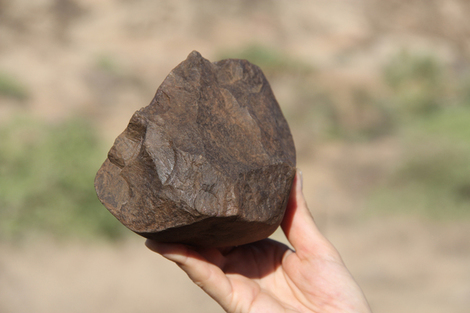
PictureCore from the LOM3 site (image source: http://www.nature.com/nature/journal/v521/n7552/full/521294a.html)
The LOM3 cores are not small.  The mean mass is 3.1 kg (6.8 pounds): that's heavier than a standard brick but lighter than your average bowling ball.  The flakes, anvils, and percussors are large, also, compared to those from later Oldowan sites and from those in assemblages produced by wild chimpanzees (p. 313). Although some artifacts have a series of flakes detached, patterns of fracture and flake removal suggest to the authors that the "precision of the percussive motion was also also occasionally poorly controlled" (p. 313):

"The dimensions and the percussive-related features visible on the artefacts suggest the LOM3 hominins were combining core reduction and battering activities and may have used artefacts variously: as anvils, cores to produce flakes, and/or as pounding tools. . . . The arm and hand motions entailed in the two main modes of knapping suggested for the LOM3 assemblage, passive hammer and bipolar, are arguably more similar to those involved in the hammer-on-anvil technique chimpanzees and other primates use when engaged in nut cracking than to the direct freehand percussion evident in Oldowan assemblages." (p. 313)

That sounds to me like a description that's pretty consistent with a manufacturing strategy based largely on chimp-like "thrusting percussion," and perhaps exactly what one would expect to precede Oldowan based on de Beaune's analysis.

What about the "why" question? What caused hominids to start using thrusting percussion to produce tools?  Answering that question is tougher than addressing the "when" and "how" questions. 

I don't think it has much to do with a change in physical anatomy -- specifically that of the hand -- for three inter-related reasons.  First, as I discussed before, I think there's a lot of evidence that suggests that hands with the capacity for human-like precision gripping were widespread among early hominids, including the australopithecines of around 3.3 MYA.  (See also this comment on australopithecine hands that just came out in Science today.)  Second, as discussed by de Beaune (p. 141-142), the physical actions required to smash one rock with another are not all that different than the actions required to smash a piece of fruit on an anvil: no new anatomy was even required to shift the "target" of the percussion to stone.  Third, even with the limitations imposed by their hand anatomy, chimpanzees can be taught to use freehand percussion to make stone tools (see this video of Kanzi, for example).

If the "invention of technology" (meaning, in this case, chipped stone technology) wasn't dependent upon a change in anatomy, what about a change in cognition?
Again following Leroi-Gourhan, de Beaune (2004:142) discusses the nature of the distinction between using a hammerstone to smash something to process food and hitting a stone with another stone to produce a cutting edge:

"While these activities involved related movements, that of intentionally splitting a cobble to produce a cutting tools, although "exceedingly simple," was in [Leroi-Gourhan's] view eminently human in that it "implied a real state of technical consciousness.""


Maybe there does have to be a cognitive change to explain the shift to producing and using stone tools.  But, as we know from the Kanzi example, there's nothing lacking in the chimp brain that prevents them from making and use simple chipped stone tools when they're taught.  But, as far as we know, they have to be taught (the last time I checked, though, humans also need to be taught to do it).

Surely an important thing to understand about the shift to using stone-on-stone percussion to make stone tools is what that shift gets you: a tool with a cutting edge unlike anything that exists in nature.  A sharp-edged flake can be used for what de Beaune calls "linear resting percussion"  (cutting and chopping).  You can do a lot of things with an edged tool that you can't do with a blunt one (and that you can't do with your teeth if, like australopithecines, you lack the large canines of chimps and many other non-human primates).  You can sharpen a stick. You can grate and slice plants. And you can cut meat from bones and disarticulate an animal carcass by severing ligaments.  We have some direct evidence of this last activity in the form of the 3.4-million-year-old cutmarked bones reported from Dikkika, Ethiopia, in 2010.  Maybe the battlefield of the hunter-scavenger debate, now several decades old, will be reinvigorated by a transplantation from the Pleistocene to the Pliocene.

Does the emergence of chipped stone technologies during the Pliocene signal an adaptive shift, a cognitive shift, or both?  With the publication of the LOM3 tools and the announcement last week of a new fossil australopithecine from about the same time period and neighborhood, East Africa 3.3 million-years-ago sounds like a pretty interesting place to be.  If, as suggested by ethnographic data from chimps, gorillas, and orangutans, the capacity to use tools is really a homology that extends deep into the Great Ape lineage, it's probably not fair to refer to the production of chipped stone tools as the "invention of technology."  But it is a watershed nonetheless.  The shift to using one set of tools (hammers and anvils) specifically to make other, qualitatively different tools (cutting implements) that potentially open up new subsistence niches and eventually (possibly) become involved in the feedbacks between biology, technology, and culture which are entangled in the emergence of our genus is something worth knowing about:  who did it?  why? what were the tools used for? what changed as a result? 

The assemblage from LOM3 opens up a tantalizing window on those questions.  In those 149 pieces of stone, we have evidence of a stone tool production strategy that used "passive hammer" techniques to produce cutting tools
, somewhere in time much closer to the dawn of stone tool production than anything called Oldowan.  Judging by the size of the cores and flakes, the technique appears to have been more dependent on brute force than finesse.  The results, however -- the creation of cutting tools from a natural setting that provided none -- may have been transformational.  I look forward to seeing how the data from the small LOM3 assemblage get incorporated into models of human evolution, and I hope that people working in East Africa are already busy finding more sites.  And I hope that people working outside of East Africa are actively searching for stone tools in Pliocene deposits.  It's a great time to be following paleoanthropology.


ResearchBlogging.org
de Beaune, S. (2004). The Invention of Technology: Prehistory and Cognition Current Anthropology, 45 (2), 139-162 DOI: 10.1086/381045
Harmand S, Lewis JE, Feibel CS, Lepre CJ, Prat S, Lenoble A, Boës X, Quinn RL, Brenet M, Arroyo A, Taylor N, Clément S, Daver G, Brugal JP, Leakey L, Mortlock RA, Wright JD, Lokorodi S, Kirwa C, Kent DV, & Roche H (2015). 3.3-million-year-old stone tools from Lomekwi 3, West Turkana, Kenya. Nature, 521 (7552), 310-5 PMID: 25993961
Leroi-Gourhan, A. (1971). L'Homme et la Matiere. Paris: Albin Michel.
<<Previous
Forward>>

    All views expressed in my blog posts are my own. The views of those that comment are their own. That's how it works.

    I reserve the right to take down comments that I deem to be defamatory or harassing. 

    Andy White

    Email me: [email protected]

    Enter your email address:

    Delivered by FeedBurner


    Picture

    Sick of the woo?  Want to help keep honest and open dialogue about pseudo-archaeology on the internet? Please consider contributing to Woo War Two.
    Picture

    Follow updates on posts related to giants on the Modern Mythology of Giants page on Facebook.

    Archives

    May 2024
    January 2024
    January 2023
    January 2022
    November 2021
    September 2021
    August 2021
    March 2021
    June 2020
    April 2020
    March 2020
    January 2020
    December 2019
    November 2019
    October 2019
    September 2019
    May 2019
    April 2019
    January 2019
    December 2018
    November 2018
    October 2018
    September 2018
    August 2018
    July 2018
    June 2018
    May 2018
    April 2018
    March 2018
    February 2018
    January 2018
    December 2017
    November 2017
    October 2017
    September 2017
    August 2017
    July 2017
    June 2017
    May 2017
    April 2017
    March 2017
    February 2017
    January 2017
    December 2016
    November 2016
    October 2016
    September 2016
    August 2016
    July 2016
    June 2016
    May 2016
    April 2016
    March 2016
    February 2016
    January 2016
    December 2015
    November 2015
    October 2015
    September 2015
    August 2015
    July 2015
    June 2015
    May 2015
    April 2015
    March 2015
    February 2015
    January 2015
    December 2014
    November 2014
    September 2014
    August 2014
    June 2014
    May 2014
    April 2014
    March 2014

    Categories

    All
    3D Models
    AAA
    Adena
    Afrocentrism
    Agent Based Modeling
    Agent-based Modeling
    Aircraft
    Alabama
    Aliens
    Ancient Artifact Preservation Society
    Androgynous Fish Gods
    ANTH 227
    ANTH 291
    ANTH 322
    Anthropology History
    Anunnaki
    Appalachia
    Archaeology
    Ardipithecus
    Art
    Atlantis
    Australia
    Australopithecines
    Aviation History
    Bigfoot
    Birds
    Boas
    Book Of Mormon
    Broad River Archaeological Field School
    Bronze Age
    Caribou
    Carolina Bays
    Ceramics
    China
    Clovis
    Complexity
    Copper Culture
    Cotton Mather
    COVID-19
    Creationism
    Croatia
    Crow
    Demography
    Denisovans
    Diffusionism
    DINAA
    Dinosaurs
    Dirt Dance Floor
    Double Rows Of Teeth
    Dragonflies
    Early Archaic
    Early Woodland
    Earthworks
    Eastern Woodlands
    Eastern Woodlands Household Archaeology Data Project
    Education
    Egypt
    Europe
    Evolution
    Ewhadp
    Fake Hercules Swords
    Fetal Head Molding
    Field School
    Film
    Florida
    Forbidden Archaeology
    Forbidden History
    Four Field Anthropology
    Four-field Anthropology
    France
    Genetics
    Genus Homo
    Geology
    Geometry
    Geophysics
    Georgia
    Giants
    Giants Of Olden Times
    Gigantism
    Gigantopithecus
    Graham Hancock
    Grand Valley State
    Great Lakes
    Hollow Earth
    Homo Erectus
    Hunter Gatherers
    Hunter-gatherers
    Illinois
    India
    Indiana
    Indonesia
    Iowa
    Iraq
    Israel
    Jim Vieira
    Jobs
    Kensington Rune Stone
    Kentucky
    Kirk Project
    Late Archaic
    Lemuria
    Lithic Raw Materials
    Lithics
    Lizard Man
    Lomekwi
    Lost Continents
    Mack
    Mammoths
    Mastodons
    Maya
    Megafauna
    Megaliths
    Mesolithic
    Michigan
    Middle Archaic
    Middle Pleistocene
    Middle Woodland
    Midwest
    Minnesota
    Mississippi
    Mississippian
    Missouri
    Modeling
    Morphometric
    Mound Builder Myth
    Mu
    Music
    Nazis
    Neandertals
    Near East
    Nephilim
    Nevada
    New Mexico
    Newspapers
    New York
    North Carolina
    Oahspe
    Oak Island
    Obstetrics
    Ohio
    Ohio Valley
    Oldowan
    Olmec
    Open Data
    Paleoindian
    Paleolithic
    Pilumgate
    Pleistocene
    Pliocene
    Pre Clovis
    Pre-Clovis
    Prehistoric Families
    Pseudo Science
    Pseudo-science
    Radiocarbon
    Reality Check
    Rome
    Russia
    SAA
    Sardinia
    SCIAA
    Science
    Scientific Racism
    Sculpture
    SEAC
    Search For The Lost Giants
    Sexual Dimorphism
    Sitchin
    Social Complexity
    Social Networks
    Solutrean Hypothesis
    South Africa
    South America
    South Carolina
    Southeast
    Stone Holes
    Subsistence
    Swordgate
    Teaching
    Technology
    Teeth
    Television
    Tennessee
    Texas
    Topper
    Travel
    Travel Diaries
    Vaccines
    Washington
    Whatzit
    White Supremacists
    Wisconsin
    Woo War Two
    World War I
    World War II
    Writing
    Younger Dryas

    RSS Feed

    Picture
Proudly powered by Weebly